Blog

  • The Iconography and Order of Tarot Cards

    The Iconography and Order of Tarot Cards

    Why these cards? Why this order?

    The cards are weird, aren’t they? Would you be able to quickly and easily memorise the order of them so that you could play the game if there were no names or numbers printedon them?

    As discussed in the post about trick-taking games, Michael Dummet identified three common orders of cards that developed in Italy. Elements of these orders (also listed in the table below) make some sense, but others are difficult to understand if one assumes that there should be a fairly obvious hierarchy to the cards so that new players could know which card triumphed over which card.

    If the cards were influenced by Petrarch’s Triumphs (this is a common assumption, but not necessarily agreed upon), why is the sequence “out of order” and also so broken up? Sure, there’s a general sense that a Pope would triumph over a Fool, and that Love might triumph over a Pope… that a Traitor might triumph over Fortune, and that The Devil would triumph over a Traitor. We seem to have a series of increasing celestial light, obvious with the Star, then Moon, then Sun, but The Tower only fits in to that group (if we want to put it there at all) if we know that originally, it probably wasn’t the tower part of the card that was important, but instead it was the lightening, the arrow lightening bolt hitting the tower illuminating the sky that, perhaps, makes some sense to be triumphed by the brighter celestial bodies. At the end of the Southern order, we have an Angel card that is always associated with the Biblical Judgement Day so “Eternity” makes sense, and if the Southern order holds any weight, but then one expect that the Hermit (Time) would be near the end, not not The World (Fame). So whilst it’s possible to make associations with Petrarch’s Triumphs in the Tarot, the order doesn’t match up with and historical sequence.

    Another obvious oddity is the lack of a fourth “Cardinal Virtue”

    Something else odd about the deck is that the cardinal virtues of Temperance, Justice, and Strength are “out of sequence” rather than grouped together, except in the “Southern” order, and oddly, they were almost always depicted outside of Tarot as a group of four, but in Tarot Prudence seems to be missing. It has been argued that if seen as the meaning The Chariot, then Prudence could be equivalent to Chastity, and in fact, in the Trionfi poems, Chastity is grouped with the other virtues, so this does make some sense in the Southern order. 

    Perhaps the only thing to explain it is simply that an earlier order was lost and the orders we do know about have things shifted about a bit. Or, there is simply only a casual relationship between Petrarch and the trumps, but if that is true, then what is the order that would make sense to players learning how to play the game?

    Michael Dummet’s list of common historical orders again.

    ORDER A: 
    The Southern Tradition
    (prototype: Tarocco Bolognese)
    ORDER B: 
    The Eastern Tradition
    (prototype: Steele Sermon)
    Order C: 
    The Western Tradition
    (prototype: Tarot de Marseille)
    the Bagattothe Bagattothe Bagatto
    the Papessthe Empressthe Papess
    the Empressthe Emperorthe Empress
    the Emperorthe Papessthe Emperor
    the Popethe Popethe Pope
    LoveTemperanceLove
    the ChariotLovethe Chariot
    Temperancethe Chariot
    JusticeJustice
    FortitudeFortitudethe Old Man
    the Wheelthe Wheelthe Wheel
    the Old Manthe Old ManFortitude
    the Traitorthe Traitorthe Traitor
    DeathDeathDeath
    Temperance
    the Devilthe Devilthe Devil
    FireFireFire
    the Starthe Starthe Star
    the Moonthe Moonthe Moon
    the Sunthe Sunthe Sun
    the Worldthe Angelthe Angel
    Justice
    the Angelthe WorldThe World

    Notice, too, that the names Dummet uses are also a bit weird to modern sensibilities? The Hermit is “The Old Man”, The Tower is “The Fire”, Judgement is “The Angel”. Without names and numbers, we really aren’t sure what the “original names” may have been or the “correct” sequence of the cards, but these old names help us understand how the cards were viewed in the 15th and 16th centuries, early in the development of Tarot cards. 

    Whilst there was some consistency in the naming of many of the trumps, there were also variations in some of the cards, particularly The Magician, The Hermit, and The Tower.  The lists of orders that we do have are from many decades after the invention of the game, and like the ordering of the cards, the names also seemed to change over regions over time.

    An attempt to make some sort of sensible order

    The ordering on the below is not attested historically, it’s completely reordered to try to reconstruct some sort of easy to learn system on what is increasingly seeming like a slightly “mismatched” collection of cards that really need  (and will eventually have!) names and numbers added on to them to help new players to learn to play the game.

    This proposed order takes into consideration that the Fool and Magician are “the lowest of the low”, that the Popes and Emperors (we’ll get into the more deeply in another post very soon) are constantly rising and falling in power, that Petrarch’s Triumphs are understood to represent an essential truth about how the world, and afterworld, work; that there are virtues to help guide us on the right path as well as “unvirtuous” allegorical figures of Fortune, Betrayal, and The Devil ready to keep us from moving forward. Then we move to the “heavenly” realm of increasing celestial light leading eventually to Time itself being Triumphed by judgement and eternity.

    a Possible SequenceModern NameHistorical Variations and meanings
    Lowest social statusThe Fool“The madman”, “The crazy one”
    Lowest social statusThe Magician“A trifle”, “a small thing of little importance”“street performer”, “juggler”, “sleight-of-hand artist”, ”the mountebank” or “the street performer”
    Temporal RulerThe High Priestess“The Popess”, “Female Pope” 
    [One of the four “Papi” in Bolognese tradition]
    Temporal RulerThe Empress[One of the four “Papi” in Bolognese tradition]
    Temporal RulerThe Emperor[One of the four “Papi” in Bolognese tradition]
    Temporal RulerThe Hierophant“The Pope” 
    [One of the four “Papi” in Bolognese tradition]
    Petrarch TriumphThe Lovers“Love”
    Petrarch TriumphThe Chariot [Chastity? Prudence??] “The Triumphal Chariot”
    Cardinal VirtueTemperance
    Cardinal VirtueJustice
    Cardinal VirtueStrength“Fortitude”
    Unvirtuous Allegorical FigureThe Wheel of Fortune
    Unvirtuous Allegorical FigureThe Hanged Man“The Traitor”, “The Hanged One”
    Unvirtuous Allegorical FigureThe Devil
    Petrarch TriumphDeath
    Increasing Celestrial LightThe Tower“The Lightening”, “The Fire”, “The Arrow”, “The House of God”, “The Devil’s House”
    Increasing Celestrial LightThe Star
    Increasing Celestrial LightThe Moon
    Increasing Celestrial LightThe Sun
    Petrarch TriumphThe World [Fame?]
    Petrarch TriumphThe Hermit [Time?]“The Old Man”, “Time”, “The Hunchback”
    Petrarch TriumphJudgement [Eternity?]“The Angel”

    There are many other possible orders that can be made depending on how the meanings of the cards are interpreted, this is just an exercise in working through one possibility.

    There’s an interesting thread on the forum that’s quite active at the moment discussing the A sequence, Bologna and Petrarch’s triumphs:

    https://forum.tarothistory.com/viewtopic.php?t=334&start=270

  • Tarot is a Game of Triumphs

    Tarot is a Game of Triumphs

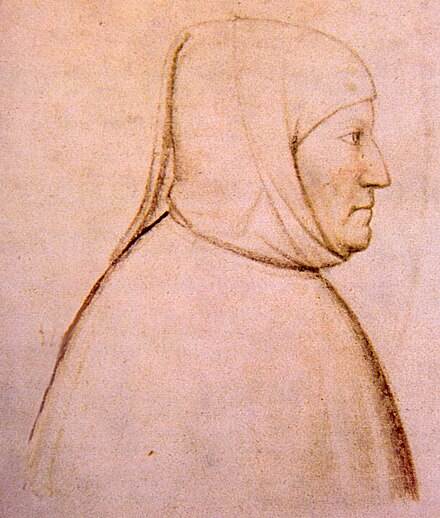
    Francis Petrarch (1304 – 1374) was an early Italian Renaissance scholar and poet. One of his most influential series of poems were “I Tronifi”, “The Triumphs”. Composed over 20 years, the poems describe six triumphs (Love, Chastity, Death, Fame, Time and Eternity) who each vanquish each other in turn. Most scholars believe it’s highly likely that this set of triumphs influenced the order of the “Trumps” (short for Triumphs) in the Tarot deck.

    Possible Connections

    If there are connections, the cards shown below from the Cary-Yale Visconti Tarot and the Visconti Sforza Tarot might correspond to the Triumphs (my matches). Some of the cards would be obvious matches, others are more conjectural

    Cary-Yale Visconti Tarot – Lovers
    Cary-Yale Visconti Tarot – World
    Cary-Yale Visconti Tarot – Chariot
    Visconti Sforza Tarot –
    Hermit
    Cary-Yale Visconti Tarot – Death
    Visconti Sforza Tarot –
    Judgement

  • Tarot is a Trick-Taking Game

    Tarot is a Trick-Taking Game

    Trick-taking games existed before Tarot

    Trick-taking card games have origins dating back to just before the emergence of Tarot, with Karnoffel in Germany being a notable example. These games are played in rounds, known as tricks, where each player plays a single card from their hand. One player starts by leading with a card, and the others follow in turn. In most cases, players are required to follow the suit of the lead card if they can. The winner of each trick—usually decided by the highest card, trump suits, or specific game rules—collects all the cards from that round and leads the next trick.

    Tarot is a trick-taking card game, and mastering it requires players to grasp the card hierarchy. For numbered cards (pips), the ranking is Ace through 10, while court cards follow the order: Page, Knight, Queen, King. In most trick-taking games, one suit is designated as the “Trump” suit before or during gameplay. This suit takes precedence over all others, allowing its cards to win over those from different suits. Unlike many traditional trick-taking games that use a standard deck, Tarot introduced a permanent, more powerful suit which would always be trump suit in every round.

    The original order of the Tarot trumps is uncertain

    The original order of Tarot cards remains a mystery, as the earliest decks lacked both numbers and titles. In his seminal work on Tarot history, The Game of Tarot, Michael Dummett identified three distinct ordering systems that emerged in various regions. While these weren’t the only arrangements, they gained the most widespread popularity. The Fool was unique, often regarded as existing “outside” the hierarchy of the other Trumps. However, much like a few other cards, it held special significance when played strategically.

    Early Tarot historians sought a unifying theme to decipher the card sequence, and a clear progression began to emerge. Remembering that each card had to triumph of the previous, the sequence suggests figures of the lowest social rank, ascending through powerful rulers, embodying virtues, evoking allegorical symbols, and culminating in celestial and heavenly forces. This narrative flow reflects a structured depiction of human experience, morality, and the divine, offering a glimpse into the societal and philosophical ideals of the time.

    Could you play the game without knowing the trump card order?

    Picture this: You’re learning how to play the game of tarot and need to learn the hierarchy of the 22 trump cards so that you know which card conquers over which card, but there are no numbers or titles! For this to work there needs to be a recognisable, iconographic order that makes sense to a new player, or at the very least… is easy to learn!

    Michael Dummet’s
    Regional Tarot Order Variations

    Tarot Historian Michael Dummet recognised that, although there were additional patterns, most of our documented history of how the game was played focused on three main sequences.

    ORDER A: 
    The Southern Tradition
    (prototype: Tarocco Bolognese)
    ORDER B: 
    The Eastern Tradition
    (prototype: Steele Sermon)
    ORDER C: 
    The Western Tradition
    (prototype: Tarot de Marseille)
    the Bagattothe Bagattothe Bagatto
    the Papessthe Empressthe Papess
    the Empressthe Emperorthe Empress
    the Emperorthe Papessthe Emperor
    the Popethe Popethe Pope
    LoveTemperanceLove
    the ChariotLovethe Chariot
    Temperancethe Chariot
    JusticeJustice
    FortitudeFortitudethe Old Man
    the Wheelthe Wheelthe Wheel
    the Old Manthe Old ManFortitude
    the Traitorthe Traitorthe Traitor
    DeathDeathDeath
    Temperance
    the Devilthe Devilthe Devil
    FireFireFire
    the Starthe Starthe Star
    the Moonthe Moonthe Moon
    the Sunthe Sunthe Sun
    the Worldthe Angelthe Angel
    Justice
    the Angelthe WorldThe World

    There have been quite a few theories over the years as to why the card orders changed. It’s easier to understand if one remembers that these cards typically didn’t have numbers or titles on them. I’ve suggested the analogy before of the localised rules for games we may have played when we were growing up. I come from a family that believed that when you went to Jail in Monopoly, instead of paying the bank, you paid your cash into the middle of the board and as others did the same, the pot grew. Eventually, the player that landed on Free Parking would win the cash in the middle of the board. This is not a rule in the actual game, but one that quickly became so common that many of us have grown up believing that it’s an official rule for playing the game!

    Francis Petrarch

    To understand the game of Tarot, we need to understand the order of the cards to make some logical sense to the players. An obviously likely connection to Taror comes from the early name for the game… “Triumphs”… from which we get the word “Trumps”, but there also was another very possible “Triumph” connected to the order of the cards: the poetry of Francis Petrarch. 

    Continue on the next page about Petrarch and his probable connection to Tarot cards.

  • The Origin of Tarot Cards

    The Origin of Tarot Cards

    Tarot cards were invented to play a new type of card game

    The game of Tarot originated in the 15th century and continues to be enjoyed as such in various parts of the world today. One enduring version is “French Tarot,” a trick-taking game similar to popular card games like “Hearts” and “Bridge” where a single suit of cards is declared more powerful than the rest. While the exact origins remain uncertain, historians have narrowed the birth of the game of Tarot down to 15th-century Italy—most likely in either Milan, Florence, Bologna, or Ferrara between the 1420s and 1440s.

    The game of Tarot descended from regular playing cards

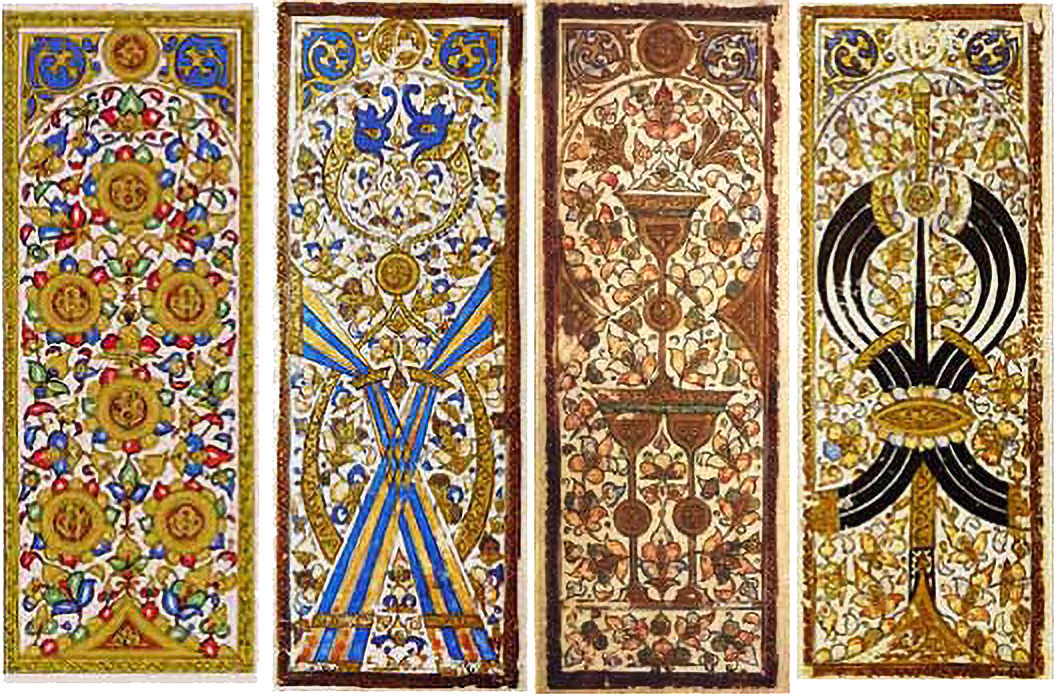
    Playing cards were already widespread across Western Europe by around 1375, having originally made their way from China during the 11th century. They traveled through the Arab world and the Mamluk Empire—probably via Egypt to Spain and the Moorish Empire—before becoming established in Europe. In the Mamluk deck, court cards featured three male figures: the King, the First Lieutenant, and the Second Lieutenant. These became the Page, Knight and King in most early European card decks.

    Coins, Polo Sticks, Cups and Swords, The Suits of the Mamluk Playing Cards adopted by Europeans and used in Tarot

    Adding a permanent fifth suit of cards

    The wonderful innovation in Tarot was adding a permanent, high-ranking, 22-card Trump suit to an ordinary deck of 52 cards. Whilst in other trick-taking games, a player would declare one of the suits (Coins, Batons, Cups or Swords) the trumps suit for the round, Tarot’s additional suit is always the highest ranking.

    Tarot also added Queens to the Court Cards

    Tarot wasn’t the only card deck to add Queens, but most decks of the time adhered to the structure of three males inherited from the Mamluk playing cards.. The reason for the addition of Queens to Tarot’s court cards remains unclear. One prevailing theory suggests that Tarot originated within royal Italian courts and there is lots of evidence that the game was enjoyed by both men and women—then including Queens might have been a deliberate choice to appeal to the courtly audience. What we do know is that Tarot quickly gained popularity, not only in the royal courts, but also with everyday people.

    The card game had a period of structural experimentation

    With the additional 4 Queens, the deck standardised over time to 78 cards.  Each 14-card suit of Batons, Cups, Swords & Coins contains 10 pips, a Page, Knight, Queen and King.

    BUT, the 22 Trumps conquer them all.