
Tarot cards were invented to play a card game
Tarot began as a card game in fifteenth-century Italy, and it is still played today. In France, Tarot is one of the most popular card games in the country, and versions are played in Austria, Italy, Switzerland and elsewhere in Europe. Like Bridge or Whist, it is a trick-taking game, but with one important difference: instead of choosing a trump suit for each hand, Tarot has a permanent suit of trumps that beats all the others.
While the exact origins remain uncertain, historians agree that the game was born in northern Italy. The first secure written reference comes from Florence in 1440, and the courts of Milan and Ferrara were playing it within a few years. Bologna is often suggested as another early home.
Where did playing cards come from?
Tarot grew out of ordinary playing cards, which were themselves fairly new to Europe. Cards first appear in European records in the 1370s. In 1377, the city of Florence banned a new game called naibbe. In the same year, a German monk, Johannes of Rheinfelden, described a deck of cards and the games played with it.
These early European cards were modelled on cards from the Mamluk Sultanate, which ruled Egypt and Syria. Their suits were Cups, Coins, Swords and Polo Sticks. Europeans, who did not play polo, turned the sticks into Batons, and these four suits are still found in Italian and tarot decks today. Cards may ultimately have reached the Islamic world from China, where card games were played centuries earlier, but the details of that journey are not known.
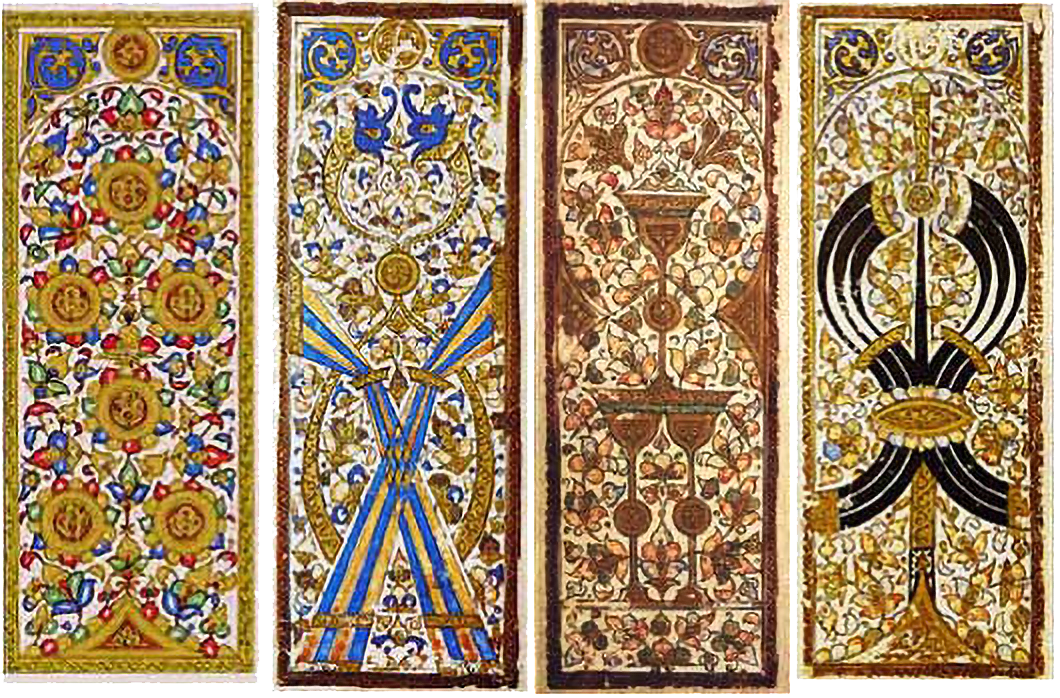
The Mamluk court cards showed no human figures, only names: the King (malik), the Deputy (na’ib) and the Second Deputy. In Europe these became the King, the Knight and the Page, or Knave.
What made tarot different?
A permanent fifth suit
The wonderful innovation in Tarot was adding a permanent, high-ranking suit of picture cards to an ordinary deck. As far as we know, this was the first true trump suit in any card game. Later games, such as Bridge and Whist, let players choose one of the ordinary suits as trumps, but that idea came afterwards and borrowed tarot’s: in Italy the picture cards were called trionfi, or triumphs, which is where our word “trump” comes from.
The standard tarot has twenty-one numbered trumps and the Fool. The Fool was not really a trump: in the game it excuses the player from following suit, which is why the French still call it l’Excuse.
Queens join the court cards
Tarot also added a Queen to each suit, giving four court cards instead of three. Tarot wasn’t the only deck of its time to include queens, but most followed the three-male pattern inherited from the Mamluk cards. Why tarot added them is unclear. One suggestion is that the game began at the Italian courts, where noblewomen played cards alongside men. What we do know is that Tarot quickly became popular, not only at court but with everyday players.
A period of experimentation
The earliest decks were not all the same. Some hand-painted decks made for the Visconti family of Milan had extra trumps showing the virtues, and extra female court cards. The Florentine game of minchiate later used ninety-seven cards. Over time, though, most of Europe settled on seventy-eight: four suits of fourteen cards (ten numbered cards, Page, Knight, Queen and King), plus the twenty-one trumps and the Fool.
BUT, the trumps conquer them all.
The first trump games
Tarot had at least one forerunner. Around 1420, Duke Filippo Maria Visconti of Milan commissioned a game from his secretary, Marziano da Tortona, in which sixteen cards showing classical gods acted as a kind of trump suit. The cards are lost, but Marziano’s description survives.
By the 1440s, carte da trionfi appear in records from Florence, in 1440, and from the court of Ferrara, in 1442. Within a few decades the game had spread across northern Italy. By the early 1500s, the cards had a new name, tarocchi, the source of the French and English word “tarot”.
What we know, and what we don’t
We know tarot began as a card game in northern Italy in the first half of the fifteenth century, and that it was built on the Mamluk-style playing cards that reached Europe in the 1370s. We don’t know who invented it, exactly where or when, why these particular trump subjects were chosen, or what the word tarocchi originally meant. Anyone who tells you otherwise with certainty is guessing.
The idea that tarot is ancient, Egyptian or secret only appeared in the 1780s, more than three centuries after the game began. That story is part of tarot’s history too, and we explore it elsewhere on this site.
Related topics on the Tarot History Forum
- Florence 1440: new earliest reference to tarot
- Playing cards in Europe before 1377?
- Pratesi’s note on Islamic cards
- What are the documents for Marziano’s dates?
- Marziano’s treatise on the sixteen gods: text and translation
- Pratesi’s notes on tarot origins
Further reading
- Michael Dummett, The Game of Tarot (1980), the foundational study
- Thierry Depaulis, Le Tarot révélé (2013)
- The Researcher’s Study on the Tarot History Forum, where these questions are discussed in depth