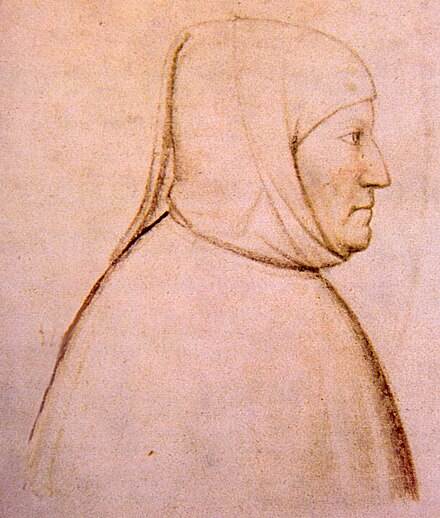
Francis Petrarch (1304 – 1374) was an early Italian Renaissance scholar and poet. One of his most influential series of poems were “I Tronifi”, “The Triumphs”. Composed over 20 years, the poems describe six triumphs (Love, Chastity, Death, Fame, Time and Eternity) who each vanquish each other in turn. Most scholars believe it’s highly likely that this set of triumphs influenced the order of the “Trumps” (short for Triumphs) in the Tarot deck.
Possible Connections
If there are connections, the cards shown below from the Cary-Yale Visconti Tarot and the Visconti Sforza Tarot might correspond to the Triumphs (my matches). Some of the cards would be obvious matches, others are more conjectural
Cary-Yale Visconti Tarot – Lovers Cary-Yale Visconti Tarot – World
Trick-taking card games have origins dating back to just before the emergence of Tarot, with Karnoffel in Germany being a notable example. These games are played in rounds, known as tricks, where each player plays a single card from their hand. One player starts by leading with a card, and the others follow in turn. In most cases, players are required to follow the suit of the lead card if they can. The winner of each trick—usually decided by the highest card, trump suits, or specific game rules—collects all the cards from that round and leads the next trick.
Tarot is a trick-taking card game, and mastering it requires players to grasp the card hierarchy. For numbered cards (pips), the ranking is Ace through 10, while court cards follow the order: Page, Knight, Queen, King. In most trick-taking games, one suit is designated as the “Trump” suit before or during gameplay. This suit takes precedence over all others, allowing its cards to win over those from different suits. Unlike many traditional trick-taking games that use a standard deck, Tarot introduced a permanent, more powerful suit which would always be trump suit in every round.
The original order of the Tarot trumps is uncertain
The original order of Tarot cards remains a mystery, as the earliest decks lacked both numbers and titles. In his seminal work on Tarot history, The Game of Tarot, Michael Dummett identified three distinct ordering systems that emerged in various regions. While these weren’t the only arrangements, they gained the most widespread popularity. The Fool was unique, often regarded as existing “outside” the hierarchy of the other Trumps. However, much like a few other cards, it held special significance when played strategically.
Early Tarot historians sought a unifying theme to decipher the card sequence, and a clear progression began to emerge. Remembering that each card had to triumph of the previous, the sequence suggests figures of the lowest social rank, ascending through powerful rulers, embodying virtues, evoking allegorical symbols, and culminating in celestial and heavenly forces. This narrative flow reflects a structured depiction of human experience, morality, and the divine, offering a glimpse into the societal and philosophical ideals of the time.
Could you play the game without knowing the trump card order?
Picture this: You’re learning how to play the game of tarot and need to learn the hierarchy of the 22 trump cards so that you know which card conquers over which card, but there are no numbers or titles! For this to work there needs to be a recognisable, iconographic order that makes sense to a new player, or at the very least… is easy to learn!
Michael Dummet’s Regional Tarot Order Variations
Tarot Historian Michael Dummet recognised that, although there were additional patterns, most of our documented history of how the game was played focused on three main sequences.
ORDER A: The Southern Tradition (prototype: Tarocco Bolognese)
ORDER B: The Eastern Tradition (prototype: Steele Sermon)
ORDER C: The Western Tradition (prototype: Tarot de Marseille)
the Bagatto
the Bagatto
the Bagatto
the Papess
the Empress
the Papess
the Empress
the Emperor
the Empress
the Emperor
the Papess
the Emperor
the Pope
the Pope
the Pope
Love
Temperance
Love
the Chariot
Love
the Chariot
Temperance
the Chariot
Justice
Justice
Fortitude
Fortitude
the Old Man
the Wheel
the Wheel
the Wheel
the Old Man
the Old Man
Fortitude
the Traitor
the Traitor
the Traitor
Death
Death
Death
Temperance
the Devil
the Devil
the Devil
Fire
Fire
Fire
the Star
the Star
the Star
the Moon
the Moon
the Moon
the Sun
the Sun
the Sun
the World
the Angel
the Angel
Justice
the Angel
the World
The World
There have been quite a few theories over the years as to why the card orders changed. It’s easier to understand if one remembers that these cards typically didn’t have numbers or titles on them. I’ve suggested the analogy before of the localised rules for games we may have played when we were growing up. I come from a family that believed that when you went to Jail in Monopoly, instead of paying the bank, you paid your cash into the middle of the board and as others did the same, the pot grew. Eventually, the player that landed on Free Parking would win the cash in the middle of the board. This is not a rule in the actual game, but one that quickly became so common that many of us have grown up believing that it’s an official rule for playing the game!
Francis Petrarch
To understand the game of Tarot, we need to understand the order of the cards to make some logical sense to the players. An obviously likely connection to Taror comes from the early name for the game… “Triumphs”… from which we get the word “Trumps”, but there also was another very possible “Triumph” connected to the order of the cards: the poetry of Francis Petrarch.
Tarot cards were invented to play a new type of card game
The game of Tarot originated in the 15th century and continues to be enjoyed as such in various parts of the world today. One enduring version is “French Tarot,” a trick-taking game similar to popular card games like “Hearts” and “Bridge” where a single suit of cards is declared more powerful than the rest. While the exact origins remain uncertain, historians have narrowed the birth of the game of Tarot down to 15th-century Italy—most likely in either Milan, Florence, Bologna, or Ferrara between the 1420s and 1440s.
The game of Tarot descended from regular playing cards
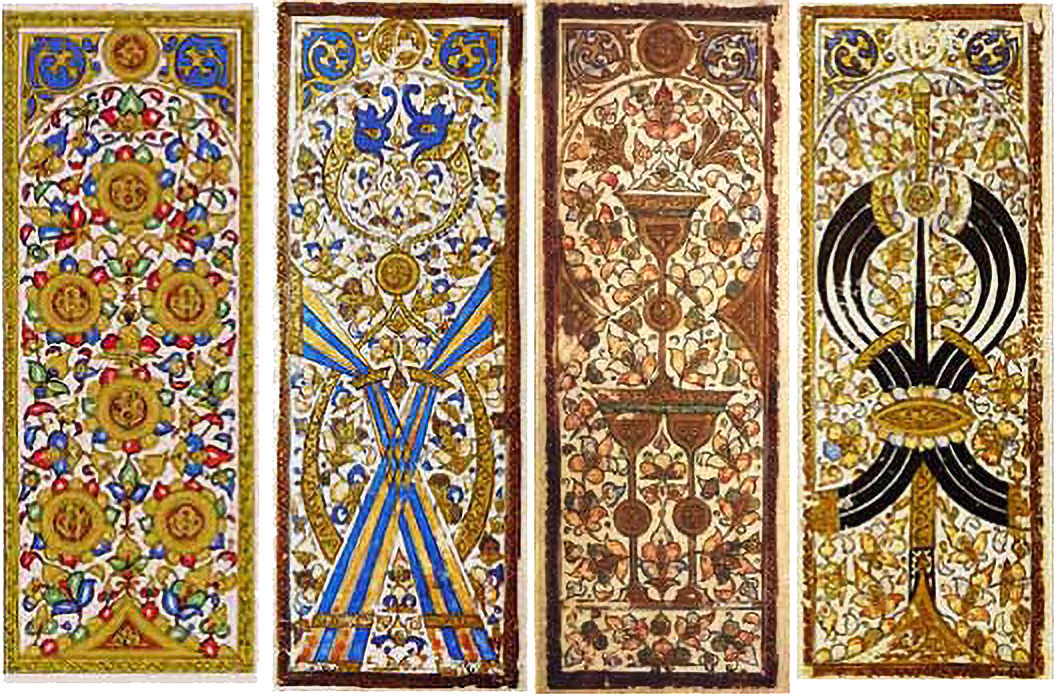
Playing cards were already widespread across Western Europe by around 1375, having originally made their way from China during the 11th century. They traveled through the Arab world and the Mamluk Empire—probably via Egypt to Spain and the Moorish Empire—before becoming established in Europe. In the Mamluk deck, court cards featured three male figures: the King, the First Lieutenant, and the Second Lieutenant. These became the Page, Knight and King in most early European card decks.
Coins, Polo Sticks, Cups and Swords, The Suits of the Mamluk Playing Cards adopted by Europeans and used in Tarot
Adding a permanent fifth suit of cards
The wonderful innovation in Tarot was adding a permanent, high-ranking, 22-card Trump suit to an ordinary deck of 52 cards. Whilst in other trick-taking games, a player would declare one of the suits (Coins, Batons, Cups or Swords) the trumps suit for the round, Tarot’s additional suit is always the highest ranking.
Tarot also added Queens to the Court Cards
Tarot wasn’t the only card deck to add Queens, but most decks of the time adhered to the structure of three males inherited from the Mamluk playing cards.. The reason for the addition of Queens to Tarot’s court cards remains unclear. One prevailing theory suggests that Tarot originated within royal Italian courts and there is lots of evidence that the game was enjoyed by both men and women—then including Queens might have been a deliberate choice to appeal to the courtly audience. What we do know is that Tarot quickly gained popularity, not only in the royal courts, but also with everyday people.
The card game had a period of structural experimentation
With the additional 4 Queens, the deck standardised over time to 78 cards. Each 14-card suit of Batons, Cups, Swords & Coins contains 10 pips, a Page, Knight, Queen and King.